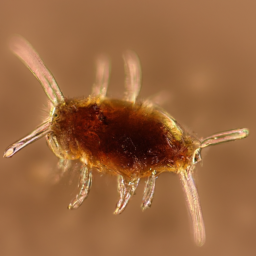
Adı : horse follicle mite
Bilimsel Adı : Demodex equi Railliet
Horse follicle mite, also known as Demodex equi Railliet, is a type of parasitic mite that lives in the hair follicles of horses. It is a microscopic organism that can cause a variety of skin problems if not properly managed.
The horse follicle mite is a common inhabitant of equine skin and is found in the hair follicles of horses. It is generally not harmful unless it reproduces excessively or the horse's immune system is compromised. In such cases, the mite can cause conditions such as mange, which is characterized by hair loss and itching.
The life cycle of horse follicle mites begins when an egg is laid in a hair follicle. The egg hatches into a larva, which feeds on skin cells and grows into a nymph. The nymphs then mature into adult mites, which mate and lay eggs to start the cycle anew.
Horse follicle mites can be diagnosed through skin scrapings or biopsies, which are then examined under a microscope. Treatment options include topical creams, oral medications, and environmental control measures. It is important to note that while horse follicle mites are not always harmful, they can cause severe skin problems if left untreated.
In conclusion, horse follicle mite, or Demodex equi Railliet, is a common parasite found in the hair follicles of horses. While generally not harmful, it can cause skin problems if not properly managed. Diagnosis and treatment involve the use of topical creams, oral medications, and environmental control measures.
Adı : horse follicle mite
Bilimsel Adı : Demodex equi Railliet
Horse follicle mite, also known as Demodex equi Railliet, is a type of parasitic mite that lives in the hair follicles of horses. It is a microscopic organism that can cause a variety of skin problems if not properly managed.
The horse follicle mite is a common inhabitant of equine skin and is found in the hair follicles of horses. It is generally not harmful unless it reproduces excessively or the horse's immune system is compromised. In such cases, the mite can cause conditions such as mange, which is characterized by hair loss and itching.
The life cycle of horse follicle mites begins when an egg is laid in a hair follicle. The egg hatches into a larva, which feeds on skin cells and grows into a nymph. The nymphs then mature into adult mites, which mate and lay eggs to start the cycle anew.
Horse follicle mites can be diagnosed through skin scrapings or biopsies, which are then examined under a microscope. Treatment options include topical creams, oral medications, and environmental control measures. It is important to note that while horse follicle mites are not always harmful, they can cause severe skin problems if left untreated.
In conclusion, horse follicle mite, or Demodex equi Railliet, is a common parasite found in the hair follicles of horses. While generally not harmful, it can cause skin problems if not properly managed. Diagnosis and treatment involve the use of topical creams, oral medications, and environmental control measures.
atların kıl foliküllerinde yaşayan parazit mikroskopik organizma cilt problemleri tıbbi tedavi topikal kremler oral ilaçlar çevresel kontrol önlemleri cilt kazıması biyopsi türkiye